

Egyptian App Sekka Wants to Make Public Transport Easier to Navigate
With over 50,000 users, Egyptian startup Sekka looks to help commuters navigate the unpredictability of Egyptian transportation.
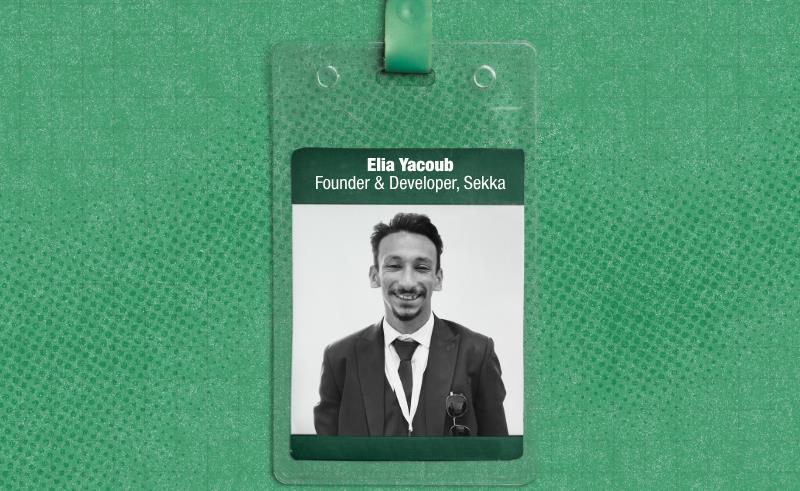
For this instalment of NextGen, our series spotlighting emerging entrepreneurs across the region, we meet Sekka, a navigation platform built to make Egypt’s public transport easier to understand and use.
The idea began with founder and software developer Elia Yacoub getting stranded in Shorouk, a satellite city east of Cairo where navigating without a car can quickly become difficult.
“I couldn’t find any transportation, and I was stuck there for two or three hours. That single incident prompted the whole idea,” Yacoub says. “And, since I was studying computer science at the time and needed to work on a graduation project, I thought, ‘Why not pursue this idea for that project?’”
Yacoub submitted the proposal for his graduation project in September 2025 and began developing it in earnest around March or April 2026. What started as coursework soon grew into something much larger.
Sekka is designed to help people plan journeys across Egypt by bringing different forms of public transportation into one system. Its Trip Planner combines metro lines, buses and microbuses, while a Metro Navigator and Route Browser let users look up specific networks and individual bus routes.
Users can search for a destination, drop a pin, use their current location or paste a Google Maps link to set a starting point. The app also accounts for walking between connections and provides metro fare estimates, while its map and routing data are stored on-device so journeys can be planned offline.
“When you travel elsewhere and ask for directions or recommendations, people will usually direct you towards an app that you can download to help you navigate the country. I want Sekka to be that bridge. I want anyone in the world to be able to navigate Egypt, easily,” Yacoub says.
Building that bridge, however, depends on something considerably less straightforward: reliable transport data.
“When I spoke to my friends about this project, many told me that it wouldn’t work because of the lack of data and how difficult it would be to gather it all in the first place,” he says.
Rather than trying to map every route from scratch, Yacoub found an existing open-source transport dataset that could serve as a foundation. Much of it, however, had become outdated. Routes had changed, fares had increased and some services listed in the data were no longer operating.
“The main goal with Sekka is to keep this information updated in real time,” he explains. “If I receive information that a particular bus is no longer operating, I can disable it from my end, and it will disappear from everyone’s phones without them needing to update anything.”
To help identify those changes, Sekka allows commuters to submit corrections directly. A user can flag an outdated fare, incorrect stop name, inactive service or alternative route, with submissions then reviewed before being incorporated.
“It’s very tricky, which is why the app allows people to contribute information themselves,” Yacoub says. “The application depends on user input.”
That system has already produced a substantial stream of information. In its first month, Sekka recorded more than 50,000 searches and over 1,150 contributions, including fare corrections, renamed stops, inactive routes and suggested alternatives. The app has since grown to more than 50,000 users.
The scale of that participation has created a new technical problem: reviewing it all. Yacoub is now developing a separate tool that can automatically process simpler contributions while routing more complicated cases for manual review.
Although he remains largely a one-person operation, he occasionally turns to friends for local knowledge, particularly when checking routes or areas they know better. But the longer-term aim is to build a system capable of maintaining itself without every correction passing directly through him.
That challenge is particularly important for Sekka’s Trip Planner, the most technically demanding part of the app. Calculating a usable journey means connecting multiple transport systems, stops, transfers and walking segments while working from information that may itself be changing.
The underlying network has expanded considerably since the project’s earliest version. Sekka began with just six stations and now contains around 3,050.
Yacoub has also had to build much of its search and routing infrastructure himself. Using services such as Google’s API at the scale he envisioned would be too expensive for a self-funded project, so he developed his own system instead.
“One of the biggest challenges has been building a search engine,” he explains. “To build an efficient search engine, you would normally use the Google API, but it’s very expensive. I’m funding the application myself right now, so I had to find another solution.”
Sekka officially launched on August 29th, 2026, following several months of development and marketing that built a waiting list of around 5,000 people.
Yacoub’s next priority is extending the app beyond Cairo while improving the reliability of the information already inside it. Over the coming year, he hopes to expand coverage across Egypt and bring the platform’s data accuracy to around 90%.
For now, he is less concerned with turning Sekka into an immediately profitable startup than with making sure it can continue operating without becoming financially unsustainable. Sponsorship is one possible route towards covering its running costs.
“My main focus isn’t revenue. The application is costly to maintain, but I can afford it for now. Hopefully, by next year, it will be able to cover its own costs. I’m not sure whether it will generate actual profit, but at the very least, I want it to fund itself,” he says.
What began with one difficult journey through Shorouk has since become an attempt to map the informal knowledge people rely on every day to move around Egypt. For Yacoub, the longer-term ambition is simple: make that knowledge easier for anyone to access, whether they have lived in Cairo their whole life or have just arrived.
- Previous Article Egypt’s Raya Ventures Backs UK AI Firm Pidima in First Investment