

EdTech Startups That Reshape How Arabic is Learned in the Digital Age
From curriculum-based platforms to AI-driven tools, these startups are developing scalable systems for teaching Arabic, reaching users across schools, institutions, and international markets.
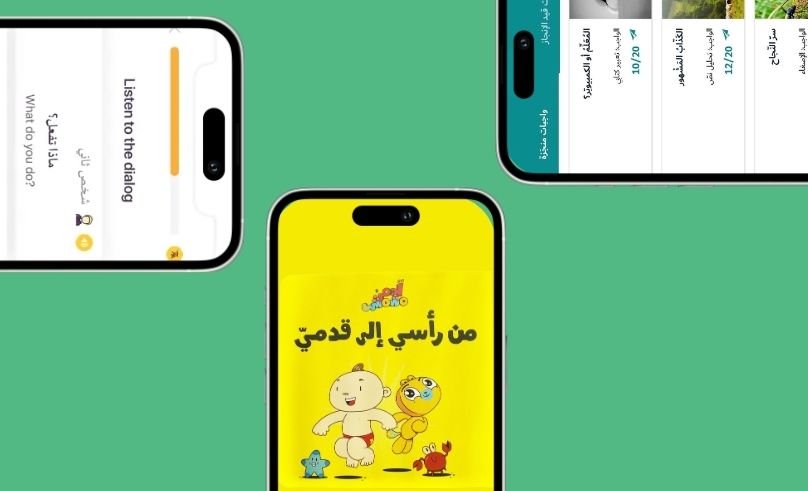
Arabic has long resisted standardisation in digital learning. Its layered structure—formal Arabic, regional dialects, and script complexity—has kept it dispersed across classrooms, tutors, and static materials. Amid this confounding landscape, a new group of startups is beginning to reorganise it, building platforms that translate the language into structured, scalable systems.
These companies approach Arabic as a product category. Mobile-first applications, adaptive learning models, and institutional tools are being developed in parallel, often extending beyond individual users into school systems and national curricula. Many are also expanding outside the region, targeting diaspora communities and non-Arab learners in markets where demand has historically been underserved.
AlifBee
Founded in 2019 with Abdalhady Alsayad as CTO, AlifBee has positioned itself around a structured approach to Modern Standard Arabic, organising the language into a level-based system aligned with international frameworks. The platform integrates reading, writing, listening, and speaking into a single progression, delivered through mobile and web interfaces. Its reach has expanded beyond individual users, with schools and institutions adopting the platform as part of formal learning environments. This dual focus of consumer access alongside institutional integration has allowed it to scale as both a product and a service layer.
Arabee
Launched in 2017 by Saeed Basweidan, Lenka Basweidan, Hala Al Ali, and Ferakh Lakhany, Arabee targets early-stage Arabic literacy within a K–12 ecosystem. The platform connects students, teachers, and parents through curriculum-aligned content and interactive tools, allowing learning to extend across both school and home settings. In 2019, the company received a $10K grant to support its development. Arabee’s structure reflects a longer-term approach to language acquisition, embedding Arabic within ongoing educational development rather than treating it as a standalone subject.
Alef Education (Arabits)
Founded in 2016 by CEO Geoffrey Alphonso, Alef Education partners with large-scale educational institutions to embed its technology into school systems. Its Arabic learning application, Arabits, forms part of a broader AI-driven platform that adapts to individual student performance using data and automation. The company’s growth strategy focuses on government and educational contracts rather than direct consumer adoption, and its scale was boosted by a $515M IPO in 2024, enabling it to reach substantial student populations within formal systems.
Adam Wa Mishmish
Established in 2016 by sisters Luma Al Adnani (CEO & Creative Lead) and Lina Al Adnani (COO & Music Lead), alongside Ibrahim Taha and Lutfi Zayed, Adam Wa Mishmish adopts a content-led approach to Arabic learning. Using music, storytelling, and character-driven formats, it introduces language concepts to younger audiences, later expanding into books, performances, and other media. The startup raised $475K in seed funding in 2021, reinforcing its model where engagement and familiarity drive language acquisition rather than traditional classroom methods.
Kamkalima
Founded in 2015 by Siroun Shamigian (CEO) and Nisrine El Makkouk (CSO), Kamkalima focuses on Arabic reading and writing through a SaaS platform designed for schools. Its system combines structured literacy content with tools that allow educators to track progress and assess comprehension. The platform’s adoption across multiple educational environments highlights the demand for robust Arabic-language resources within formal curricula, particularly in regions where digital content has historically been limited. Kamkalima’s growth was supported by a $1.5M Series A raise in 2018.
Kaleela
Launched in 2019 by Zaid Ahmad Atoom (Founder & CEO), Kaleela is designed primarily for non-native Arabic learners, focusing on both Modern Standard Arabic and regional dialects. The platform combines structured lessons with conversational content, reflecting how the language is used in practice. By directly addressing spoken Arabic, it engages learners seeking practical communication skills, a segment often overlooked by more formalised systems.
- Previous Article Proptech estaie Raises Seven-Figures in Pre-Seed for Saudi Expansion