

How Gaza Sky Geeks Is Keeping Gaza’s Tech Talent Alive After the War
Since 2011, Gaza Sky Geeks has trained more than 60,000 people in digital freelancing. Two years after the war destroyed its offices and scattered its staff, it is rebuilding from the ground up.
In late September 2023, tech training hub, Gaza Sky Geeks (GSG), was preparing for its busiest October on record. The organisation had circulated invitations for the graduation ceremony of its largest-ever cohort of graduates. A travelling hackathon connecting programmers across Gaza and the West Bank was scheduled for the same month. More than 100 people were expected to attend.
None of it happened. Within days of october 7th, Israeli strikes hit the Al Rimal neighbourhood of Gaza City, destroying GSG's primary office. The building's windows blew out, equipment was obliterated, and the surrounding streets filled with rubble. All three of the organisation's co-working spaces in Gaza were eventually lost.
Two years later, Rand Safi, GSG's senior programme manager, is speaking from Ramallah, where the organisation has relocated the majority of its operations. The staff headcount inside Gaza - which stood at roughly 36 people before October 2023 - is now five. The West Bank team has grown from four to nearly 20. "A lot of our team members unfortunately left Gaza," Safi says. "And a lot of our team members also shifted to working with humanitarian emergency response under Mercy Corps."

"The organisation has lost community members, instructors, and startup owners to the war. We haven't stopped working in Gaza, even with all the horrible circumstances."
Gaza Sky Geeks was founded in 2011 as a joint initiative between Mercy Corps and Google, which contributed an initial grant of $900,000. Because Israeli restrictions on the movement of people and goods made conventional commerce nearly impossible in Gaza, the internet was the only viable route to international markets.
Gaza's digital economy emerged from necessity; the territory has long suffered from a non-functioning market system and unemployment rates that, even before the war, hovered around 45% overall and reached 65% among young people. With limited prospects for conventional employment and severe restrictions on the movement of people and goods, tens of thousands of Gazans turned to the internet. Before October 2023, an estimated 30,000 young people in Gaza were working online as developers, designers, and marketers. The ICT sector - comprising mostly freelancers, startups, and remote workers - contributed around 4%, or $641 million, of total Palestinian gross national product in 2022, not accounting for the substantial unreported revenue earned by freelancers working outside formal platforms.
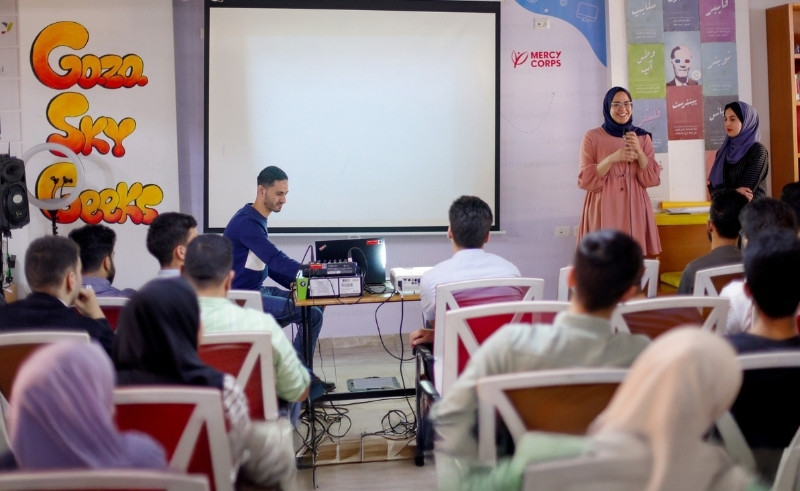
Safi describes the organisation's evolution across three axes. "Since 2011, Gaza Sky Geeks evolved on three levels," she says. "Number one, the offerings that we are delivering changed - we had more focus on tech education, because we realised that in order to create a startup, what you need is actually the tech talent for people to build the startups. Number two, we grew in terms of funding. We were a small initiative, mainly funded through local sources, and then we got bigger. And number three, we grew in terms of the number of people working in Gaza Sky Geeks."
The freelancing programme, which GSG launched in 2017, was the first of its kind in Gaza. "We were the first organisation in Gaza to start freelancing, which is one of the main pillars of the Palestinian economy in Gaza," Safi says. By the time of the war, graduates of that programme had collectively generated more than $20 million in online revenue over ten years. The average monthly income for a new graduate within their first six months sits at around $700. "Once they are seniors, after like one year, it might grow up to $1,000 - but depending on the specialisation, the techies can reach $2,000 and more," Safi says.
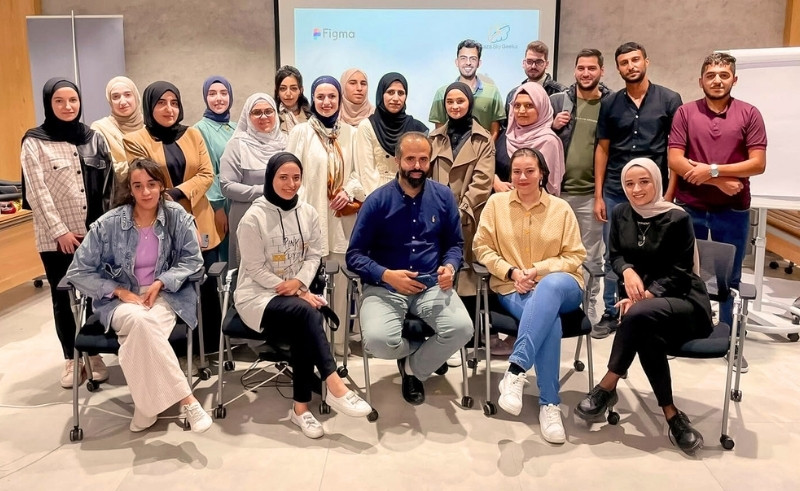
"Palestine has a very limited and small local market in Gaza, and there are all the limitations when it comes to running a local business and working there," Safi says. "So we started working with partners and started the coding academy, and then we did the freelancing academy." Gaza Sky Geeks had, by 2023, trained more than 60,000 participants, with an average of 4,500 completing a programme annually. More than half of all participants across its programmes have been women.
Before October 2023, GSG was executing what Safi describes as a "wider and deeper" strategy. "We wanted to scale our operations and reach a larger number of people and we wanted to focus more on specialisation, so we can be more competitive in the international market." The organisation had expanded beyond individual training to working with Palestinian tech companies directly, helping them build capacity and acquire clients overseas.
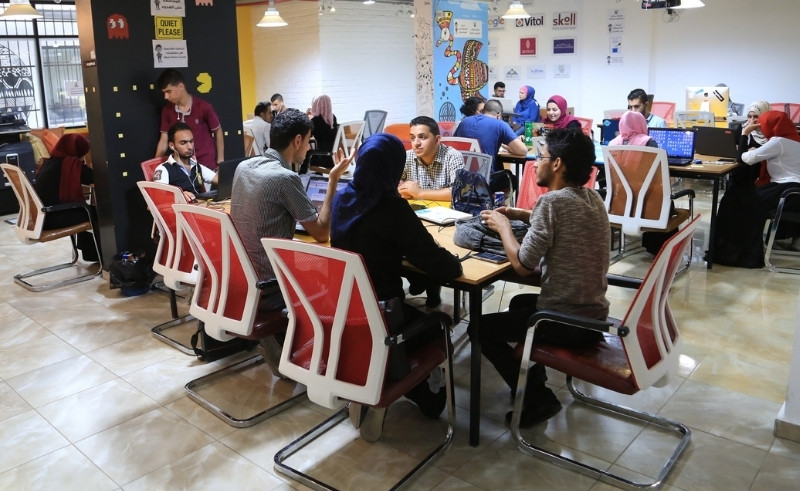
The war stopped that trajectory and GSG found itself pivoting its Gaza-based staff almost entirely to humanitarian emergency response. Around 30% of the Gaza team escaped to Egypt in the immediate aftermath and have since dispersed further, to Belgium, Germany, France, and elsewhere. The West Bank expansion, which had begun in 2018, became by necessity the organisation's operational centre. "In 2018 we started the expansion outside because we thought this was such a very important programme that we needed to basically extend it to other areas in Palestine," Safi says.
One of the more striking economic behaviours to emerge in the war's first weeks was what happened on freelancing platforms. Safi recalls that a group of Egyptian freelancers began completing assignments on behalf of displaced Palestinian counterparts on platforms like Upwork, so that the Palestinians' ratings, built over years, would not collapse during a period when they had no electricity, no internet, and no fixed address.
"From November 2023 up until March 2024, a lot of the freelancers in our communities were not working because they were mainly moving from one place to another," Safi says. After March 2024, the calculus shifted. "People started to realise that this will take longer than expected. And they started to go back. Being a freelancer gives you the flexibility to hand over your projects on a timeline - but it forces you to be online all the time."
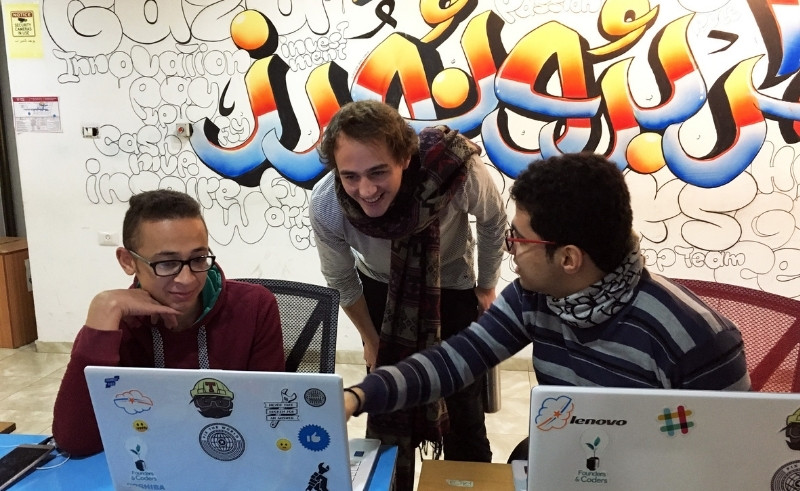
For those who managed to maintain connectivity - often via solar chargers or car batteries - freelancing became one of the few income sources that did not require physical access to a functioning economy. "A lot of people used freelancing, at least to get some income to sustain them and sustain their family," Safi says.
Safi identifies three structural challenges facing tech talent development in Gaza today. "People being displaced is basically one of the most important challenges, and how does that affect their accessibility to internet and electricity," she says. GSG is trying to address this through its co-working space initiative. In August 2025, it launched a pilot subsidising the internet and electricity costs of five operational spaces still functioning inside Gaza. The early results, Safi says, suggest the model is scalable.
The second is the speed of the global tech market. "The tech world is very quick, changing and evolving," she says. "Over the past two years, AI was introduced and people were adapting and learning - we managed to conduct a couple of training sessions there. But it's not as solid as we would have hoped it would be."
The third, and perhaps the most persistent, is employment. "In order for tech talent to have access and acceleration when it comes to experience, they will need to have jobs, no matter what training or experiential training, which is our model, you need hands-on." Safi says. "At the moment, this is one of our biggest challenges, because we have a lot of graduates and a lot of people who are willing and want to break through, but there are not enough opportunities locally. And unfortunately we need to work on our reach internationally and to overcome the challenges for people to hire people from Palestine."
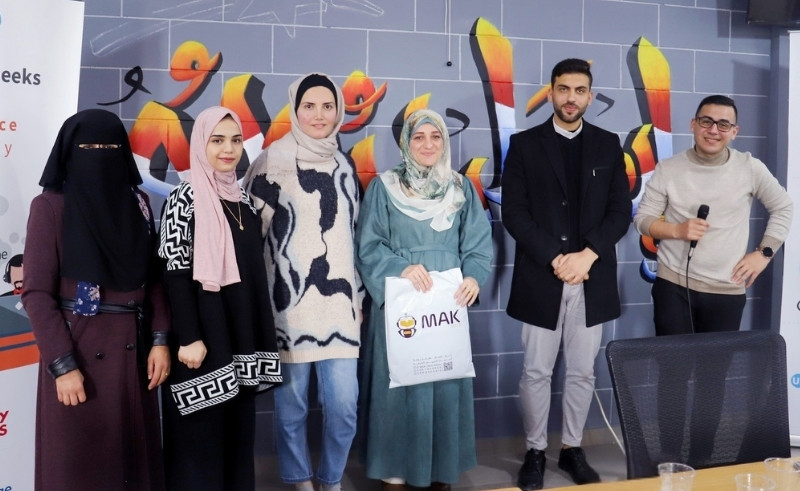
All programmes are currently running online. In-person sessions in Hebron and Nablus happen once a month, largely to hold the community together. Inside Gaza, the five remaining staff members support local companies and freelancers while delivering remote training in parallel.
Safi outlines four priorities for the next three to five years; returning to Gaza and restoring in-person operations; expanding support to Palestinian tech companies seeking international clients; increasing job and internship placements; and raising the seniority level of the talent pool. "We are still committed to the same mission and vision of Gaza Sky Geeks that we've had," she says. "It's just that the tools and the way that we're doing things have changed over the years."
What GSG needs most immediately from the international business community comes down to two things; mentors, and companies willing to host Palestinian interns. "People can volunteer their time - two hours, three hours a month - and be a mentor for a Palestinian talent," Safi says. On the internship side, the organisation is prepared to subsidise the financial cost. "All we care about is for people to have real work experience," she says.
Gaza Sky Geeks is the only tech hub and startup accelerator of its kind in Gaza, a designation that has not changed since 2011, and that the war has done nothing to make it easier to hold. "Gaza is considered to be the place that has the biggest number of people holding PhDs relative to geographic location," she says. "The human capital is there, and it is prepared. I'm hoping in the coming years that we will be able to go back and grow our presence in Gaza."
- Previous Article Six MENA Startups Tackling Water Scarcity Through Climate Tech
- Next Article Factory MENA Maps Egypt’s Hidden Manufacturing Network